
Rowbuy weight pairs: what the scale says and what the bill says
Four pairs that decide the freight payment. All numbers here come from the line data behind Rowbuy's public shipping estimator, replayed on October 22, 2026, and every worked example can be repeated on the calculators page.
Scale reading versus dimensional weight
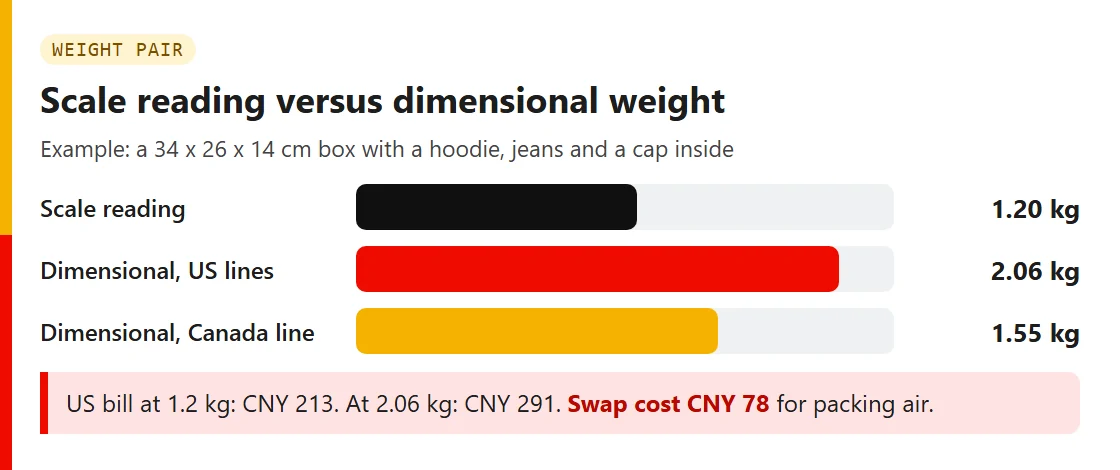
Scale reading
What the parcel weighs on a scale, in grams.
Carrier weighing at the warehouseDimensional weight
What the parcel would weigh if billed on its size: box volume divided by the line divisor.
Line rules: divisor 6,000 for the US lines, 8,000 for CanadaSwap costpacking light, bulky clothes in a big box and being billed on air.
Rowbuy's weight article says it in one line: "Light, bulky items are charged on volumetric weight." It does not print the divisor, but the line data behind its estimator does: 6,000 on both US lines and 8,000 on the Canada line. The bill uses whichever reading is larger.
Take a box 34 cm long, 26 cm wide and 14 cm deep with a hoodie, a pair of jeans and a cap inside, 1.2 kg on the scale. Its volume is 12,376 cubic centimetres. Split by 6,000 that is 2.06 kg, so the US lower-rate line bills about 2.06 kg, not 1.2. At Rowbuy's US rule of CNY 135 for the first 500 g and CNY 39 for each further 500 g, that is CNY 291 instead of CNY 213. On the Canada line, 8,000 gives 1.55 kg and the gap shrinks to CNY 28.40.
The fix is in the article too: consolidate, and remove unnecessary packaging. Shoe boxes and rigid gift boxes are the usual culprits.
First weight unit and the units after it
First weight unit
The minimum a parcel is charged for. On the US lines, 500 g at CNY 135.
Estimator FAQ: "1st Weight Unit"Units after it
Every further step, charged per started step: CNY 39 or 40 per 500 g on the US lines.
Same FAQ, second sentenceSwap costadding a 30 g cap to a 480 g parcel and paying CNY 39 for it.
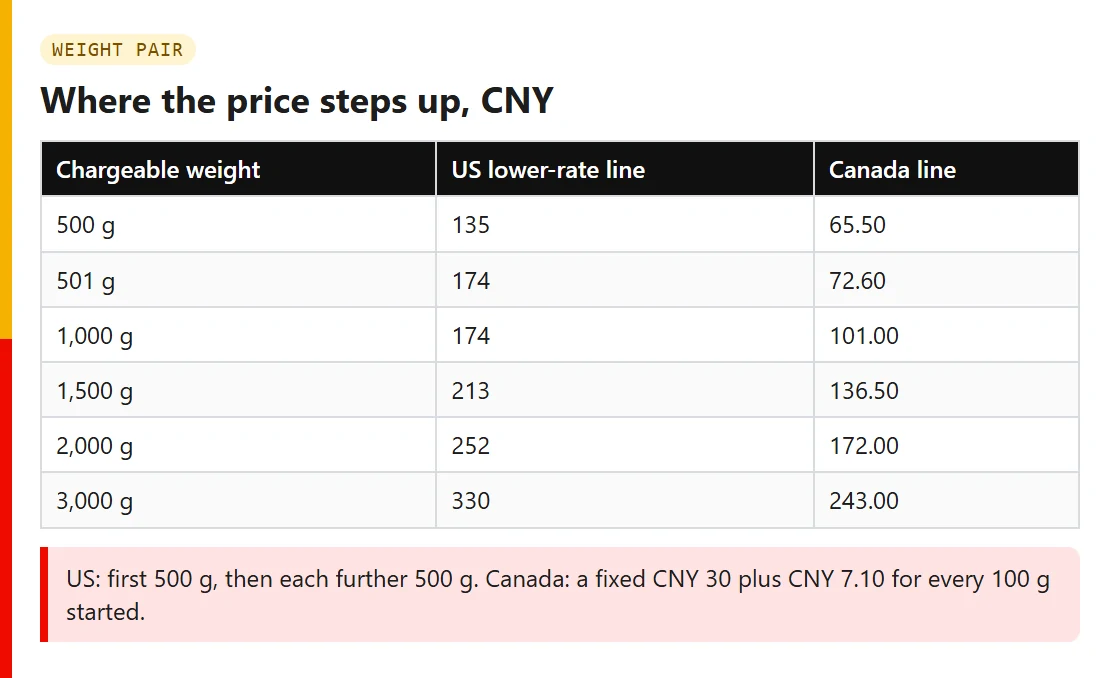
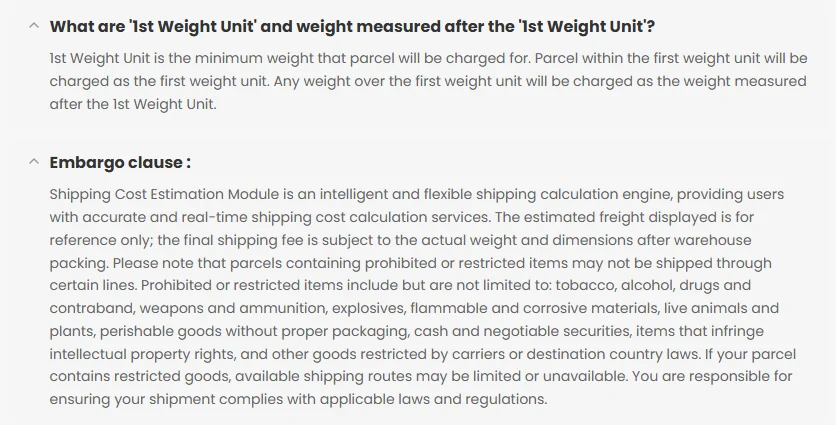
The FAQ under Rowbuy's estimator defines it: the first weight unit "is the minimum weight that parcel will be charged for", and anything over it is charged as weight "measured after the 1st Weight Unit". In the US line data the first unit is 500 g and later units are 500 g each, counted upward, so 501 g bills the same as 1,000 g.
The Canada line is built differently. It opens with CNY 30 and adds CNY 7.10 for each 100 g block you start, from 100 g up to 30 kg. Small steps mean a few extra grams cost little. On the US lines, look at where your parcel sits inside its 500 g step. A parcel at 1,040 g is paying for 1,500 g; adding a 300 g item costs nothing extra, while removing 50 g of packing drops a whole step.
Estimator figure and carrier-verified charge
Estimator figure
What the public estimator returns for a weight, size and country you type in.
rowbuy.com/freightEstimationCarrier-verified charge
What you pay, set by the weight and size measured after warehouse packing.
Parcel submission, after packingSwap costquoting an estimate to yourself as a price, then disputing the freight bill when the packed box is larger.
The estimator page is public and needs no login. Its own fine print, the "Embargo clause" under the form, says the figure "is for reference only; the final shipping fee is subject to the actual weight and dimensions after warehouse packing." Rowbuy's fee article repeats it: the final fee is confirmed against the carrier-measured weight and size.
The estimator is a planning figure, while the final charge uses the packed parcel’s measured weight and dimensions. Compare the same destination, eligible line and services when checking the difference. A larger final box, different packing or corrected measurements can change the charge; the final bill can move either way.
A useful comparison: keep your items and destination fixed, then run the calculator once with the original packaging and once with the smaller dimensions the warehouse says are achievable. If both versions round into the same chargeable band, removing packaging does not reduce that line’s freight. If they cross a band, compare the saving against the protection you would lose. See the weight calculator and warehouse decisions.
United States pricing shape and Canada pricing shape
United States lines
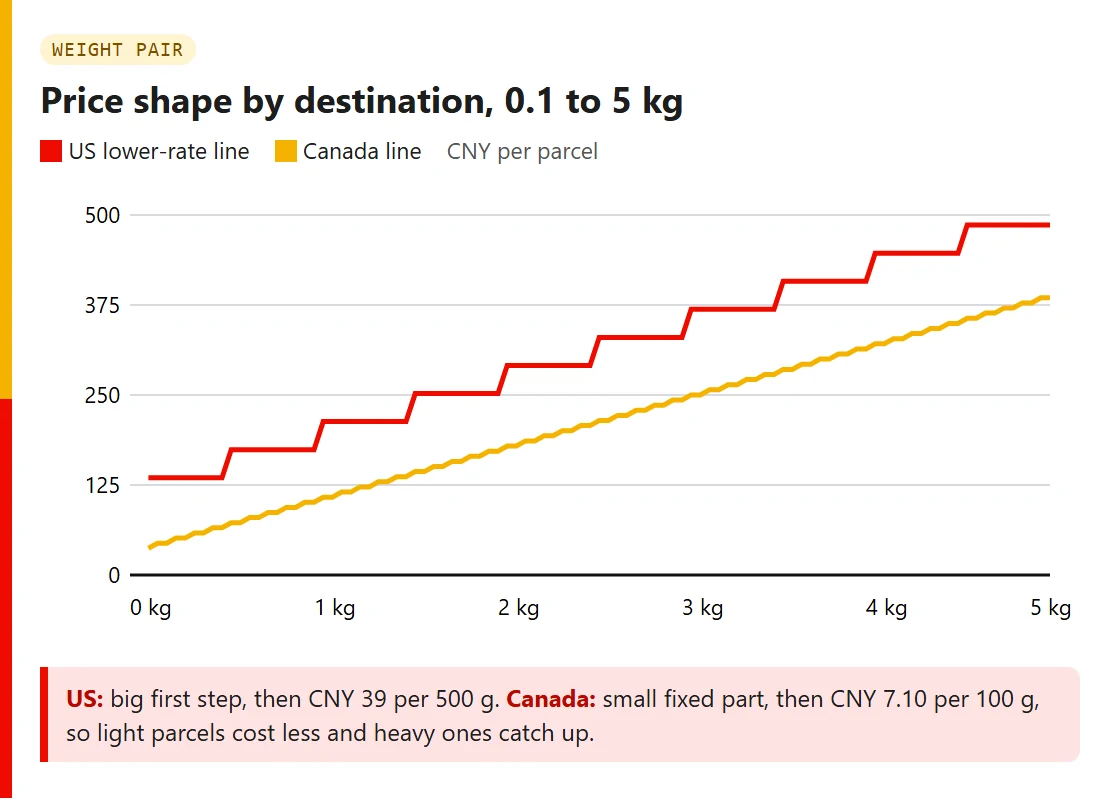
Two lines. First 500 g CNY 135, then CNY 39 or 40 per 500 g. Quoted 7 to 11 days.
Estimator with United States selectedCanada line
One line. A CNY 30 base, CNY 7.10 for each 100 g block, 30 kg at most. Quoted 7 to 11 days.
Estimator with Canada selectedSwap costreading a friend's US freight bill as a guide to a Canadian one, or the other way round.
When we replayed the estimator for 1 kg and 3 kg on October 22, only two countries returned any line: the United States and Canada. Britain, Spain, Italy, Germany and France all came back empty, even though the help article says Rowbuy ships worldwide. So for most of Europe the honest answer on that date was no published route.
The two shapes differ more than the totals suggest. A 500 g parcel costs CNY 135 to the US and CNY 65.50 to Canada; at 3 kg the figures are CNY 330 and CNY 243. Canada is cheaper at every weight we computed up to 5 kg, with the gap widest for light parcels. If you ship to the US, the second US line in the data is CNY 1 more per 500 g step; we do not repeat its internal name here.
Previous family: money pairs. Next family: warehouse pairs. All pairs: the pair index.